[ For Teams, Leaders, & Organizations ]
TURN AI LEARNING INTO AN IMPLEMENTATION PLAN THE BUSINESS CAN ACTUALLY USE.

Courses can build knowledge. Tools can create possibilities.
Neither one tells your organization what deserves to be implemented, who owns it, what people need to learn, where human review belongs, or how AI fits the work already being done.
Smart Brand System™ helps leadership move from scattered AI activity into a practical implementation strategy built around the business, the people, and the work.
Starting investment: $6,500
LEARNING AI IS NOT THE SAME AS IMPLEMENTING IT.
Many organizations already have people using AI.
Someone is testing ChatGPT. Another department is using Gemini. Employees are taking courses. New tools are being requested. Leaders are hearing that the company needs an AI strategy.
Activity increases quickly.
Consistent implementation often does not.
The result can be more subscriptions, more experiments, duplicated work, uneven adoption, and very little agreement about what deserves to become part of the way the organization actually operates.
The problem is not always a lack of training.
Sometimes the missing piece is the implementation strategy.
START WITH THE BUSINESS, NOT THE TOOL
First determine what you are trying to improve.
AI implementation begins with the work.
What is taking too long?
Where is information getting stuck?
What work is repeated?
Where does inconsistency create problems?
What decisions require better information?
Where could AI support employees without replacing the judgment and accountability they still need to provide?
Only then do we determine what technology, learning, workflow, or support belongs in the solution.
WHAT WE ASSESS
Depending on the organization and scope, the strategy process may review:
• Business priorities and leadership goals
• Current AI tools, subscriptions, and experiments
• How employees are already using AI
• Recurring workflows and operational bottlenecks
• Existing training and learning resources
• Skill and confidence gaps
• Department or role-specific needs
• Customer-facing AI use
• Human review and approval requirements
• AI policies, permissions, privacy, and governance considerations
• Visibility and customer-discovery opportunities involving Google and AI
• Existing processes that may need improvement before AI is added
The goal is not to find somewhere to put AI.
The goal is to identify where AI can support work that actually needs to improve.
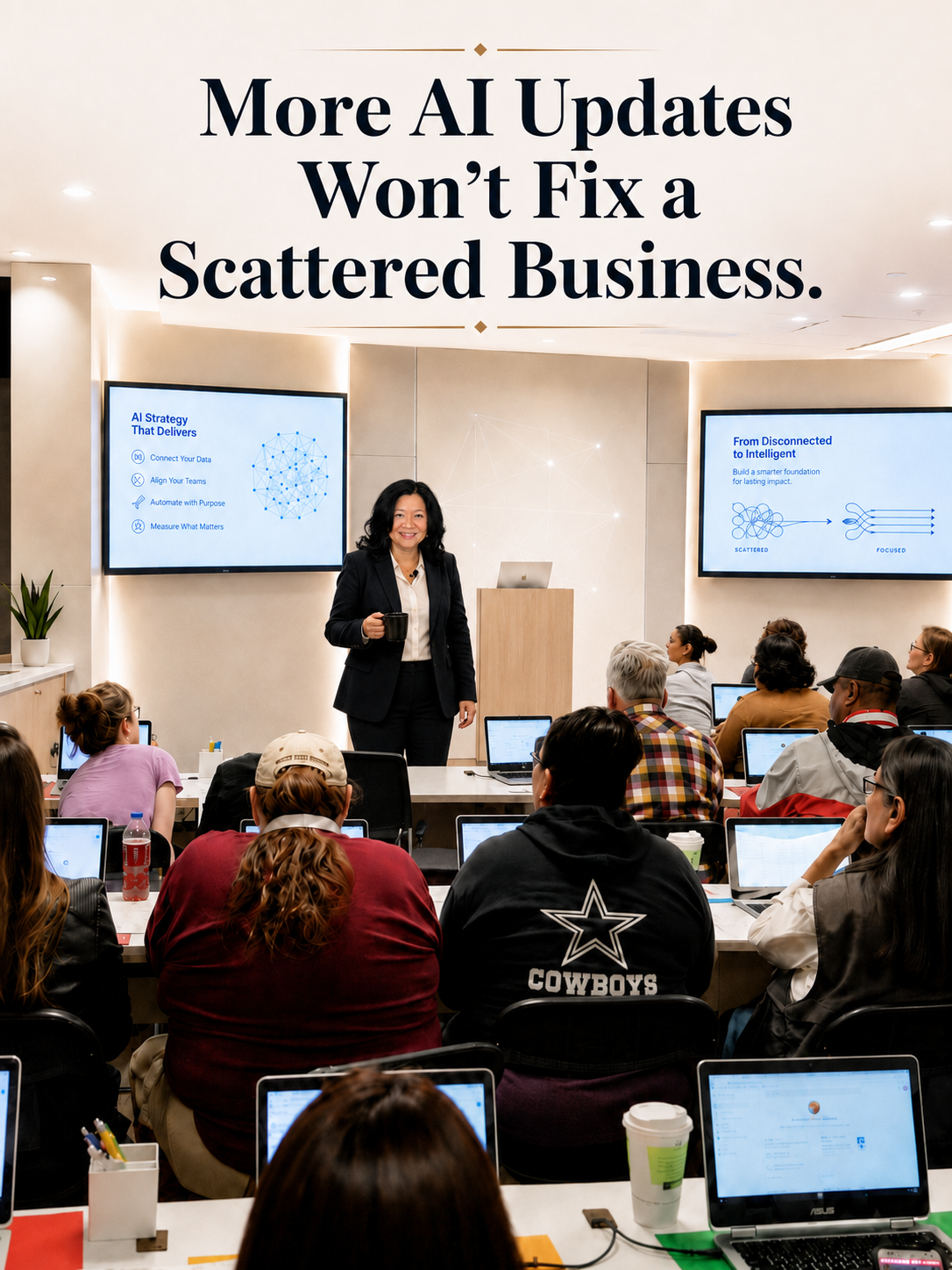
WHAT GETS PRIORITIZED
Not every AI opportunity deserves implementation.
Your strategy identifies:
• What to move forward now
• What needs more evaluation
• What can wait
• What does not need AI at all
• What employees need to learn
• What leadership needs to decide
• What requires human review
• What process needs to change first
• What success needs to look like
This helps the organization stop treating every new tool, course, or idea as another urgent priority.
LEARNING SUPPORTS THE IMPLEMENTATION
Your organization may need training. It may not need more of the same training.
Once the priorities are clear, Maria Elena can help determine what people actually need to learn to support the implementation plan.
That may include:
• Customized Smart Brand System™ training
• Leadership sessions
• Team workshops
• Internal company learning
• Existing learning resources
• Outside education or certification
• Role-specific learning pathways
• A combination of several approaches
Maria Elena is not limited to recommending one program or provider.
The recommendation is based on what the organization is trying to accomplish and what will help its people move the work forward.
THE IMPLEMENTATION ARCHITECTURE
Connect learning to what happens next.
The strategy connects each major priority through a practical implementation path:
BUSINESS GOAL
What are we trying to improve?
↓
USE CASE
Where could AI practically support the work?
↓
LEARNING NEEDED
What does the person or team need to understand first?
↓
WORKFLOW
How will the work actually happen?
↓
OWNER
Who is responsible for moving it forward?
↓
HUMAN REVIEW
Where do judgment, approval, and accountability remain?
↓
MEASUREMENT
How will we know whether it is helping?
↓
NEXT ACTION
What happens first?
WHAT YOU LEAVE WITH
Your final recommendations are shaped around the scope of the engagement and may include:
• Current-state assessment
• Prioritized AI opportunities
• Recommended use cases
• Learning and capability recommendations
• Workflow recommendations
• Human-review and ownership structure
• Governance considerations
• 90-day implementation priorities
• Success measures
• Leadership recommendations
• Recommended training or outside learning when appropriate
You leave with a strategy leadership can review, assign, and act on.


GUIDED BY THE S.M.A.R.T. BRAND STANDARD™
Technology changes quickly. Sound business judgment still matters.
Every recommendation is evaluated through The S.M.A.R.T. Brand Standard™:
Source. Meaning. Authority. Risk. Trust.
That means we look beyond whether a tool can do something.
We also ask whether the information is appropriate, whether the use fits the business, who remains responsible, what could go wrong, and whether the decision protects the trust the organization has built.
HOW THE ENGAGEMENT WORKS
1. DISCOVER
We assess the goals, current AI activity, team needs, workflows, learning resources, and implementation challenges.
2. PRIORITIZE
We identify which opportunities deserve attention first and which ideas need to wait.
3. ARCHITECT
We connect business priorities, learning needs, workflows, ownership, human review, and measurement into a practical implementation path.
4. REVIEW
Leadership receives the recommendations and works with Maria Elena to clarify priorities, responsibilities, and next actions.
OPTIONAL 90-DAY AI IMPLEMENTATION ADVISORY
Some organizations are ready to take the plan and run with it.
Others want experienced guidance as implementation begins.
A separate 90-day advisory engagement may include:
• Leadership implementation reviews
• Progress and adoption check-ins
• Learning-progress review
• Workflow refinement
• Evaluation of new AI requests or opportunities
• Accountability against the agreed priorities
• Guidance when an implementation decision needs to change
This support is scoped separately after the implementation strategy is complete.
This engagement is a strong fit for:
• Leadership teams already discussing AI adoption
• Organizations with employees using different AI tools independently
• Companies investing in AI education but struggling with application
• Teams with several possible AI use cases and no clear priority
• Organizations that want human oversight built into AI use
• Companies trying to reduce random experimentation and tool overload
• Leaders who want a practical path before investing more in technology or training
WHO THIS IS FOR



WHAT THIS IS NOT
This is not a generic AI course.
It is not a software-selection sales pitch.
It is not a promise to automate every process.
It is not an attempt to replace people with technology.
It is a strategic engagement designed to help leadership determine where AI belongs, what people need, and how to move the right opportunities into practical implementation.

READY TO MOVE FROM AI ACTIVITY TO AI IMPLEMENTATION?
Tell us what your organization is working on.
We will help determine whether AI Implementation Strategy & Architecture is the right starting point or whether a different training, strategy, or learning path makes more sense.
Starting investment: $6,500